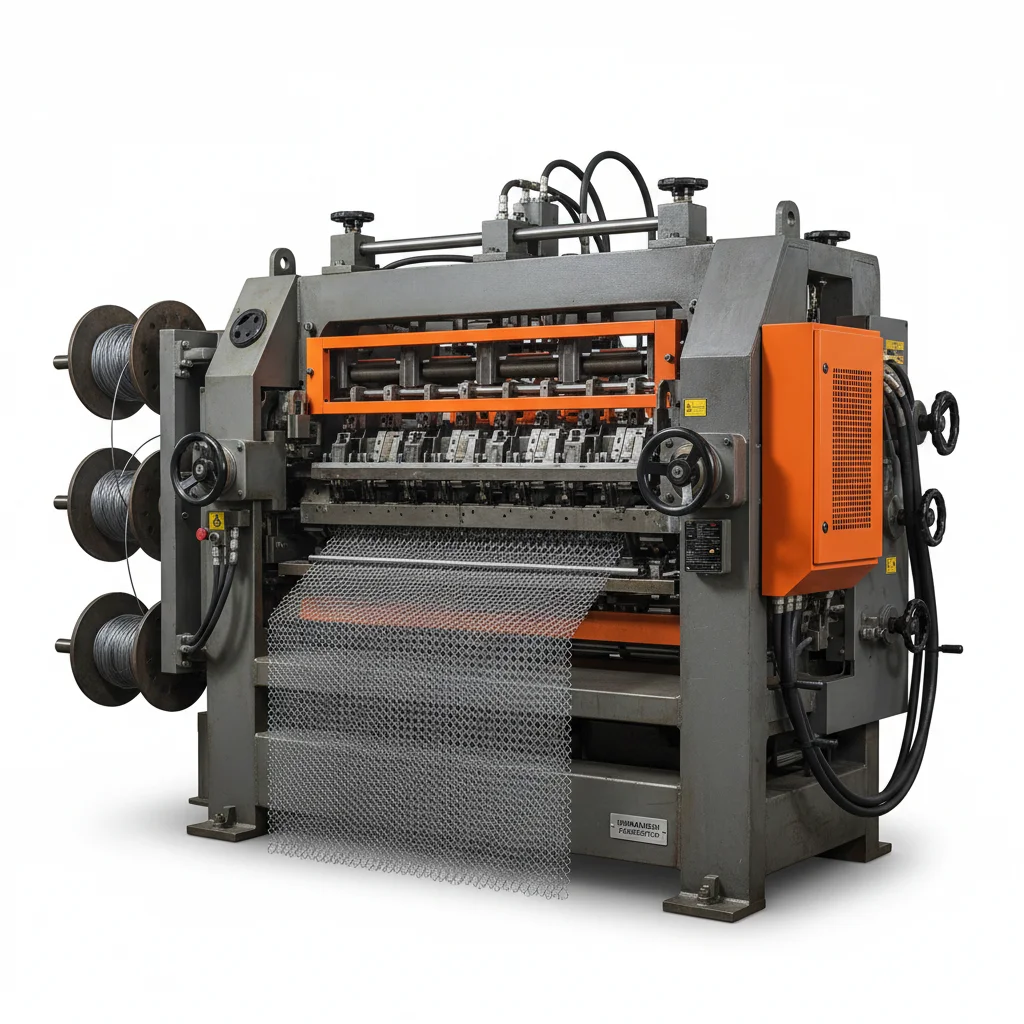
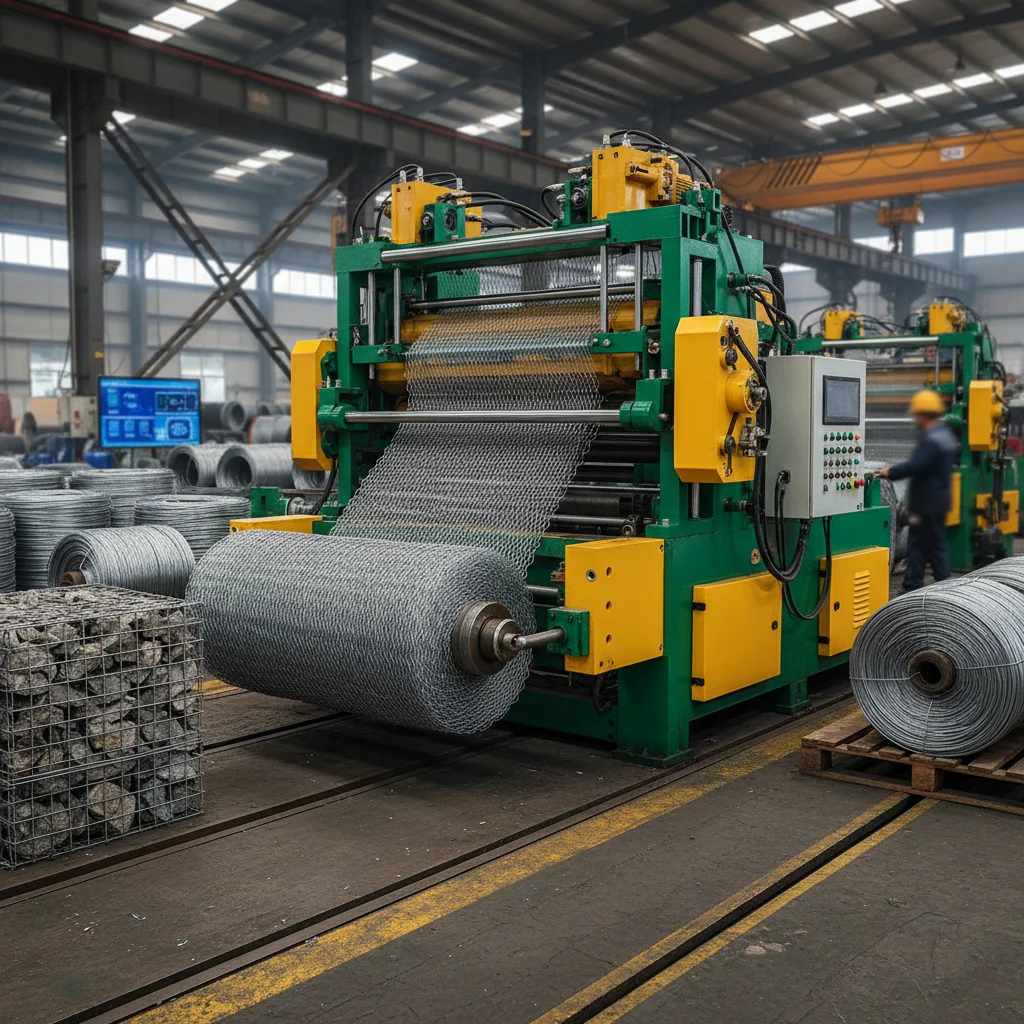
Selecting a high-performance gabion wire mesh machine is no longer just about acquiring a piece of hardware; it is a strategic decision that impacts the structural integrity of civil engineering projects worldwide. From riverbank stabilization to retaining walls, the precision of the woven hexagonal mesh determines the longevity of the installation.
For manufacturers in the specialized equipment sector, the transition toward automation and servo-driven systems has redefined what is possible in terms of weaving speed and mesh accuracy. The industry is shifting away from cumbersome programming toward intuitive PLC systems that allow for rapid adjustments in real-time.
This analysis explores the technical benchmarks of heavy-duty gabion weaving technology, evaluating how integrated rack designs and timed lubrication systems reduce operational downtime and increase overall production ROI.

Engineering the Core of Heavy-Duty Gabion Weaving

At its essence, a professional gabion wire mesh machine must balance raw power with extreme precision. The primary challenge in weaving heavy-gauge wire (ranging from 2.0mm to 4.0mm) is maintaining a consistent mesh size while ensuring the twist remains secure under tension. This requires a rigid frame and a high-torque drive system to prevent mechanical deflection.
Modern heavy-type machines utilize a dual-rack design to distribute the physical load of the weaving process. By empowering both front and rear racks, the equipment achieves a more stable output, which is essential for mesh sizes like 5070mm or 80100mm that are standard in large-scale erosion control projects.
Beyond the frame, the integration of PLC (Programmable Logic Controller) technology has removed the need for tedious electronic cam programming. Operators can now switch between three, five, or seven twists with a single key press, allowing for rapid adaptation to different project specifications without stopping production for hours.
Technical Advantages of Servo-Driven Automation Systems
The shift to full servo motor power sources marks a significant leap in machining accuracy. Unlike traditional belt-driven systems, servo motors allow for precise control over the rotation state of the thorn shaft, enabling an arbitrary switch between intermittent and continuous rotation.
Maintenance is further optimized through timed circulation lubrication. By utilizing fully enclosed lubricating oil tanks on both sides of the machine, the system prevents dust and metallic impurities from entering the operating mechanism. This not only extends the lifespan of the core components but also ensures that the machining speed remains constant over long production cycles.
Furthermore, the patented integrated double rack design reduces the spatial footprint of the machinery while enhancing stability. This streamlined structure ensures that the high-weight main engine (often exceeding 18 tons) does not suffer from vibration-induced inaccuracies, which is a common failure point in lower-end alternatives.
Critical Application Scenarios for Industrial Gabion Mesh
Gabion mesh produced by high-precision machinery is indispensable in civil engineering. The most prominent application is in riverbank and shoreline protection, where the mesh must hold massive amounts of stone to dissipate wave energy and prevent soil erosion. In these environments, the security of the twist—controlled by the machine's PLC data—is what prevents the basket from bursting under hydrostatic pressure.
Beyond water management, these machines support the production of retaining walls for highway construction and landslide prevention. The ability to customize mesh widths and diameters allows engineers to specify exact wire gauges for different soil loads, ensuring the resulting structure meets international safety standards for infrastructure.
Additionally, specialized variations such as tree root baskets and grassland fencing leverage similar weaving principles. The versatility of a professional weaving line allows a manufacturer to pivot between heavy industrial gabions and lighter agricultural fencing by simply adjusting the wire diameter and twist parameters via the PLC interface.
Analyzing Production Efficiency and Mechanical Accuracy
When evaluating the performance of a gabion wire mesh machine, two metrics stand above the rest: the weaving speed (cycles per minute) and the deviation in mesh size. Traditional mechanical machines often struggle with "creep," where the mesh size drifts as the machine heats up during a shift.
The implementation of servo-driven controls and a rigid 18-ton main engine stabilizes these variables. By maintaining a constant torque and utilizing a timed lubrication cycle, the machine reduces friction-induced heat, which in turn maintains the dimensional accuracy of the hexagonal cells across thousands of meters of mesh.
gabion wire mesh machine Performance Metrics
As illustrated in the data, the transition to a specialized PLC heavy-type system significantly boosts output consistency and reduces the waste associated with setup errors. The ability to switch twist data instantly means the machine spends more time in a "productive state" and less time in "adjustment state."
Strategic Procurement and Operational Integration Tips
Procuring a gabion weaving system requires looking beyond the sticker price. A common mistake is underestimating the importance of the "main engine weight." A lightweight machine may be cheaper to ship, but it will inevitably suffer from vibration, leading to irregular mesh sizes and increased wear on the servo motors.
Buyers should prioritize equipment that offers a fully integrated ecosystem, including the spring winding machine and the cutting machine. When these components are synchronized via a single PLC logic, the workflow from raw wire to finished gabion basket becomes seamless, reducing the need for manual handling and secondary processing.
Operational integration also depends on the ease of debugging. Equipment that avoids cumbersome cam programming in favor of digital data switching allows a smaller team of operators to manage a larger fleet of machines, effectively lowering labor costs and increasing agility in responding to custom order requirements.
Evolution of Wire Mesh Machinery and Future Trends
The trajectory of the wire mesh industry is moving toward "intelligent weaving." We are seeing a gradual integration of IoT sensors that can detect wire breakage or tension drops in real-time, triggering an automatic stop to prevent the production of defective mesh. This transition from reactive to proactive maintenance is becoming a requirement for high-volume exporters.
New materials are also influencing machine design. While galvanized steel remains the standard, there is a growing demand for polyester (PET) and other composite coatings. This requires machines to be adaptable in terms of gripping pressure and weaving tension to avoid damaging the coating during the twisting process.
Future developments are likely to focus on further reducing the energy footprint of the main drive. The adoption of higher-efficiency servo motors and optimized gear ratios could potentially increase weaving speeds while lowering the power consumption per meter of mesh produced, aligning the industry with global sustainability goals.
Comparing Gabion Equipment Configurations for Optimal ROI
To maximize return on investment, manufacturers must match the machine configuration to their primary market. A facility focusing on massive coastal projects requires a heavy-type machine capable of 4.0mm wire, whereas an agricultural fence provider would prioritize speed and versatility over raw frame weight.
The following comparison highlights how different technical approaches impact production outcomes across various operational scales.
| Equipment Type | Drive System | Primary Use Case | Key Performance Factor |
|---|---|---|---|
| Heavy-Duty PLC | Full Servo | Riverbank/Coastal | High Stability/Precision |
| Standard Automatic | Hybrid Motor | Retaining Walls | Balanced Output Speed |
| Light-Gauge Weaver | Mechanical Drive | Garden/Agriculture | High Volume/Low Cost |
| Customizable Mesh | PLC Controlled | Specialized Projects | Rapid Parameter Change |
| Integrated Line | Synchronized PLC | Full-Scale Factory | Minimized Labor Cost |
| Entry-Level Manual | Gear-Driven | Small Local Workshops | Low Initial Investment |
Ultimately, the decision should be based on the projected volume and the required wire gauge. For those aiming for the international market, the precision offered by a heavy-type, servo-driven system is generally the only way to consistently meet strict government engineering specifications.
Frequently Asked Questions
Conclusion
The production of industrial-grade gabion mesh is a balance of mechanical strength and digital precision. By moving toward servo-driven systems and rigid, high-mass frames, manufacturers can ensure that their output meets the rigorous demands of modern civil engineering projects while minimizing operational waste.
For companies evaluating their production capacity or looking to upgrade their current weaving technology, reviewing the technical specifications and integrated solutions available through www.htmeshmachines.com can provide the necessary roadmap for sustainable growth.